The food warehouses
Oświęcim, the food stores beside the Judenrampe
Site 2 of 12
In the programmes
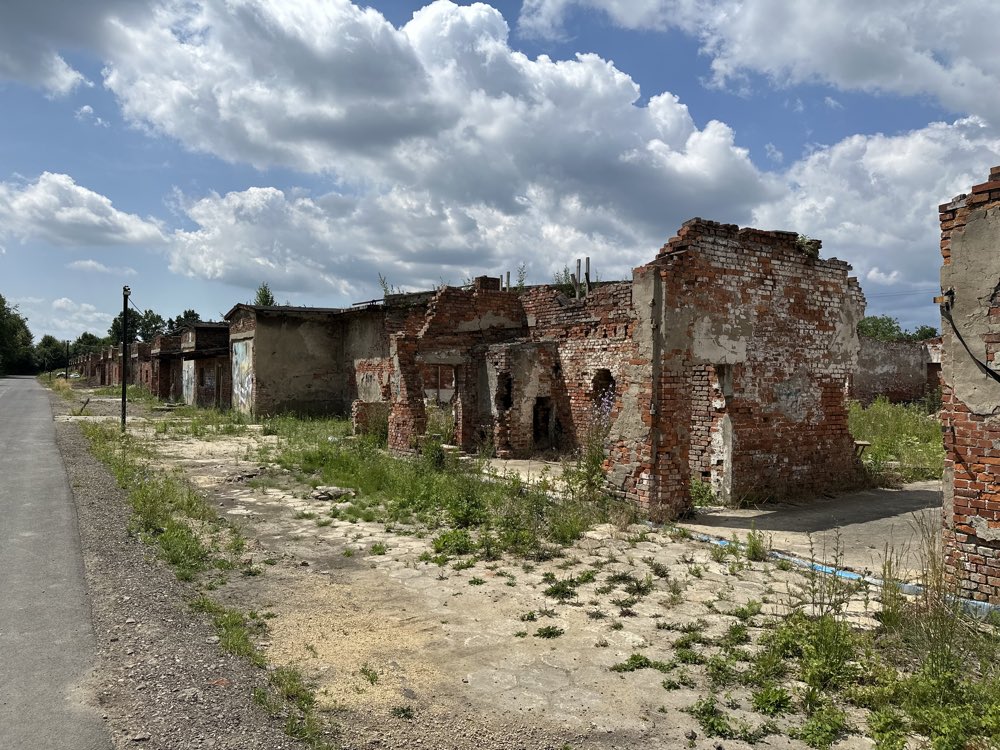
Brick halls right beside the ramp, from which the whole complex was supplied. The clearest proof that Auschwitz was a business.
In German they were called Kartoffellagerhallen, halls for storing potatoes. They stand a few hundred metres from the Judenrampe, on the same siding, and that is no accident: goods arrived by rail and went straight into store. From here food was distributed to the main camp, to Birkenau and to the subcamps scattered across the whole region.
This place says something about the camp that cannot be seen from behind the wire. Auschwitz also had suppliers, invoices, issue quotas and people who kept those books. The prisoners' rations were an item calculated in it to the gram, set so that a man would work for a few months and then go under. Hunger here was not the result of chaos or of shortages. It was a decision written into a table.
The buildings still stand, in open fields, some of them without roofs. We walk between them and show where the unloading ramp was, where the chambers were, how the whole circulation worked. For many groups this is the moment when the subject stops being an abstraction and becomes logistics.
Photo: Auschwitz Subcamps. Our own description, based on field documentation, on material of the Auschwitz-Birkenau State Museum in Oświęcim and on historical studies.
Auschwitz Subcamps is a brand of KrakowOmnia sp. z o.o.
ul. Rakowicka 10B/4, 31-511 Kraków, Poland · KRS 0001046320 · VAT PL6751785068 · operations: AllInKrakow
© 2026 KrakowOmnia sp. z o.o. The texts and photographs are ours. Terms of use